
Why lift training is essential for safety
Working at height is one of the riskier tasks in many businesses — both in construction and civil engineering, maintenance, industry and service. The use of personal lifts (“lifts”) provides efficient and flexible access, but at the same time requires a high degree of competence, risk assessment and safety routines. Lack of training, poor maintenance or incorrect use of lifts has proven to be a common denominator in serious occupational accidents.
As a course provider within HSE and safety, it is important for us at GTM to communicate that we do not just offer courses - we offer safety, documentation and a professionally rooted solution that allows businesses and individuals to work with the lift as a tool, not as a risk.
In this article, you will get a thorough review of what a lift course includes, who must take it, the legal and regulatory requirements, typical pitfalls, how the course is conducted in practice, and not least why the choice of supplier matters for quality and reliability.
What is a lift course – and why is it required?
A " lift course " (often called a personnel lift course or a course in the use of personnel lifts ) is training that is intended to ensure that anyone who uses personnel lifts in the workplace has sufficient knowledge about the use, control and maintenance of the lift - as well as the risk factors that apply.
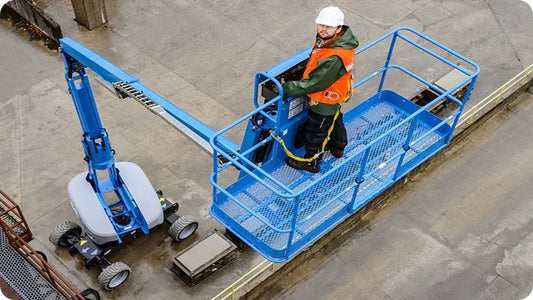
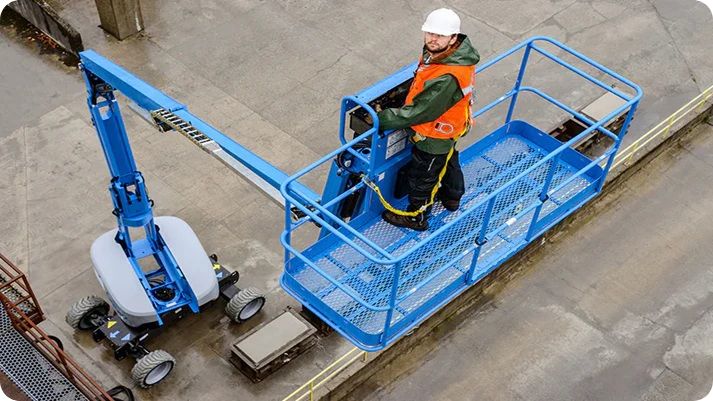
The term "person lift" covers work equipment that lifts people to a work site - for example, scissor lifts, boom lifts, trailer- or vehicle-mounted lifts.
Norwegian legislation requires that workers who will be using a lift have received practical and theoretical training for the relevant type of lift and area of application. This means that general theory is not enough – the training must be relevant to the equipment and the situation in which it will actually be used.
The measures are required because improper use of personnel lifts often leads to serious incidents: tipping, falling from the platform, crushing, collision with a fixed obstacle or electrical hazard.
For course providers and businesses, this means that the course program must be structured, documented and adapted to the equipment – and that the employer is responsible for ensuring that the training is actually completed.
The Norwegian Labour Inspection Authority's training requirements
According to the Norwegian Labour Inspection Authority, several key requirements apply when using personal lifts. Here are some of the most important:
Documented training
– Anyone who will use a lift must have documented training, both theoretical and practical.
– The training must be “equipment-specific” – that is, adapted to the type of lift used.
– The employer can only assign a person to use the lift if that person has received such training.
When the training concerns work equipment covered by the Regulations on the Performance of Work Section 10-2, it must be offered by a certified company. The course must be complete – even if it consists of several modules – and include a practical test.
Employer's responsibility
The employer is responsible for ensuring that the employee using the lift has received proper training and that the work equipment is suitable and risk-assessed. In addition, documentation of the training must be available.
Legal basis
The training requirements are based on, among other things:
- Regulations on the performance of work (order no. 703) Section 10-2: requirement for documented safety training when using work equipment.
- Working Environment Act, Chapter 3, 3-2: general requirement for a safe working environment and training.
Inspection and maintenance
In addition to training, it is required that lifts are CE marked, that they undergo expert inspection (most often annually) and that documentation for this is available.
How a lift course works – theory and practice
A good lift course consists of both theory and practical parts – so that participants not only understand how the lift works, but also have experience in using it safely and in accordance with the instructions and risk assessment.
The theory part
Typical topics covered:
- Laws and regulations (including Regulations on the performance of work § 10-2)
- Risk assessment when using personal lifts
- Types of lifts and class divisions (class A, B, C)
- Control and maintenance – including daily check, function test, documentation
- Use of protective equipment and fall protection where relevant
- Safe use – correct setup, terrain assessment, stability, load limitation
- Accidents and incidents – what often goes wrong?
Practical part
The internship can take place either in the course room/practice area or in the company's own premises. The participant performs various tasks on the lift under supervision, for example:
- Setting up and checking the lift
- Platform Maneuvering
- Safe movement at height
- Reaction to error situation or emergency stop
- Installation in rough terrain, monitoring of safety during cooling and loading
Course certificates or certificates of competence are issued after passing the theoretical and practical parts.
Duration and implementation
The length of the course varies by class and offer, but many organizers offer one-day courses (approximately 7-8 hours) for classes A and B.
Online theory components are becoming increasingly common, often combined with practical components at a later date.
Class divisions
- Class A : Person lifts where the center of gravity is always within the tipping point – example scissor lifts.
- Class B : Person lifts with boom or articulated arm where the center of gravity may be outside the tipping point.
- Class C : Vehicle-mounted personal lifts.
Typical causes of accidents with lifts
To understand why training is so critical, it's helpful to look at what most often goes wrong.
- Fall from platform : Operator standing on railing, not using fall protection or standing in the wrong position.
- Overturning or tipping : Incorrect setup, uneven surface, overload or insufficient stability.
- Crushing or impact : When the lift is driven close to edges, other vehicles, obstacles or in traffic.
- Electric shock or contact with live parts : Immediate danger from contact with high voltage or faulty insulation.
- Incorrect attachment of the equipment, lack of maintenance or insufficient control : Often the cause of sudden malfunctions.
- Lack of risk assessment : The employer has not surveyed conditions such as surface, weather, height, passengers, etc.
Training that combines knowledge and practical skills significantly reduces risk – for the operator, colleagues and the business.
Who needs to take a lift course?
There are several groups that should – and often must – complete a lift course :
- Employees who will use personal lifts in their daily work.
- Contractors, fitters, electricians, plumbing personnel and others who work at heights.
- Companies that rent out lifts or have employees who operate lifts in varied environments.
- Employers and managers who are responsible for ensuring that employees have relevant training and that the equipment is in proper condition.
- People who already have lift skills, but need a refresher or are changing class or type of lift.
According to several course and training providers, there are no formal prerequisites for participating in a lift course . The age limit for independent use of personal lifts is usually 18 years , but courses can be taken earlier with certain restrictions and under supervision.
The benefits of taking a lift course at GTM
When you choose a course at GTM, you get more than just a standard introduction – you get security, documentation, and a partner who takes security seriously:
- Our courses are based on current regulations and recommendations from the Norwegian Labour Inspection Authority.
- Our instructors have practical experience and can give you both theory and "real-life" practice.
- We offer flexibility: online courses for theory, combined with practical training in your area or at a partner.
- Course certificates and documentation are issued so that you meet the requirements for documented training.
- We focus on understanding: Participants should not just "pass", but be able to use the lift safely, correctly and effectively.
- We help the business's management with documentation and routines - security for both operator and employer.
By choosing GTM as your training partner, you send a clear signal that safety is a priority, not just a formality.
How to complete the course (practical info)
Registration and prerequisites
No prior knowledge required for most standard lift types. You can register via our website or contact us for an in-house program.
Theory and practice part
- The theory part: often as an online course or classroom – covers laws, risk assessment, classification, need for fall protection, inspection and maintenance.
- Practical exercise: Practice on the lift under a knowledgeable instructor – operation, control, emergency situation.
- Final test/exam: The participant must show that he/she has understood both theory and practice.
Duration
The usual duration for a standard course (class A/B) can be approximately 7-8 hours (one day).
Evidence and documentation
After completing the course, you will receive a course certificate showing that you have documented safety training. Your employer should archive the documentation.
In-house course
For businesses, we can tailor courses with attendance at your location, combined with online courses for employees - so you save time and cost without compromising on quality.
Summary and call for proposals
The use of personal lifts offers great opportunities – but also clear requirements and responsibilities. By choosing a solid lift course, the business ensures both employee safety and legal documentation. At GTM, we offer courses that cover requirements for documented training, good practice and flexibility – so that you, as an operator or employer, can be confident that the job is done safely and in compliance with regulations.